
Quick answer: A UAE business is valued through its sector as much as through its numbers. Trade businesses are judged on working capital and supplier terms. Financial institutions are judged on regulatory capital and return on equity. Construction firms are judged on order book quality and cash conversion. Manufacturers are judged on capacity and capital spending. Real estate companies are judged on the income and market value of their assets. The method should follow the business model, not the other way round.
A distributor in Dubai and a contractor in Abu Dhabi can report the same EBITDA and still deserve very different valuations. Yet many owners walk into a sale, a fundraising round or a shareholder buyout carrying one rule of thumb, usually a multiple of earnings, and expect it to hold everywhere. Buyers, lenders and auditors do not work that way, and a valuation that ignores sector economics rarely survives their questions.
Why these five sectors
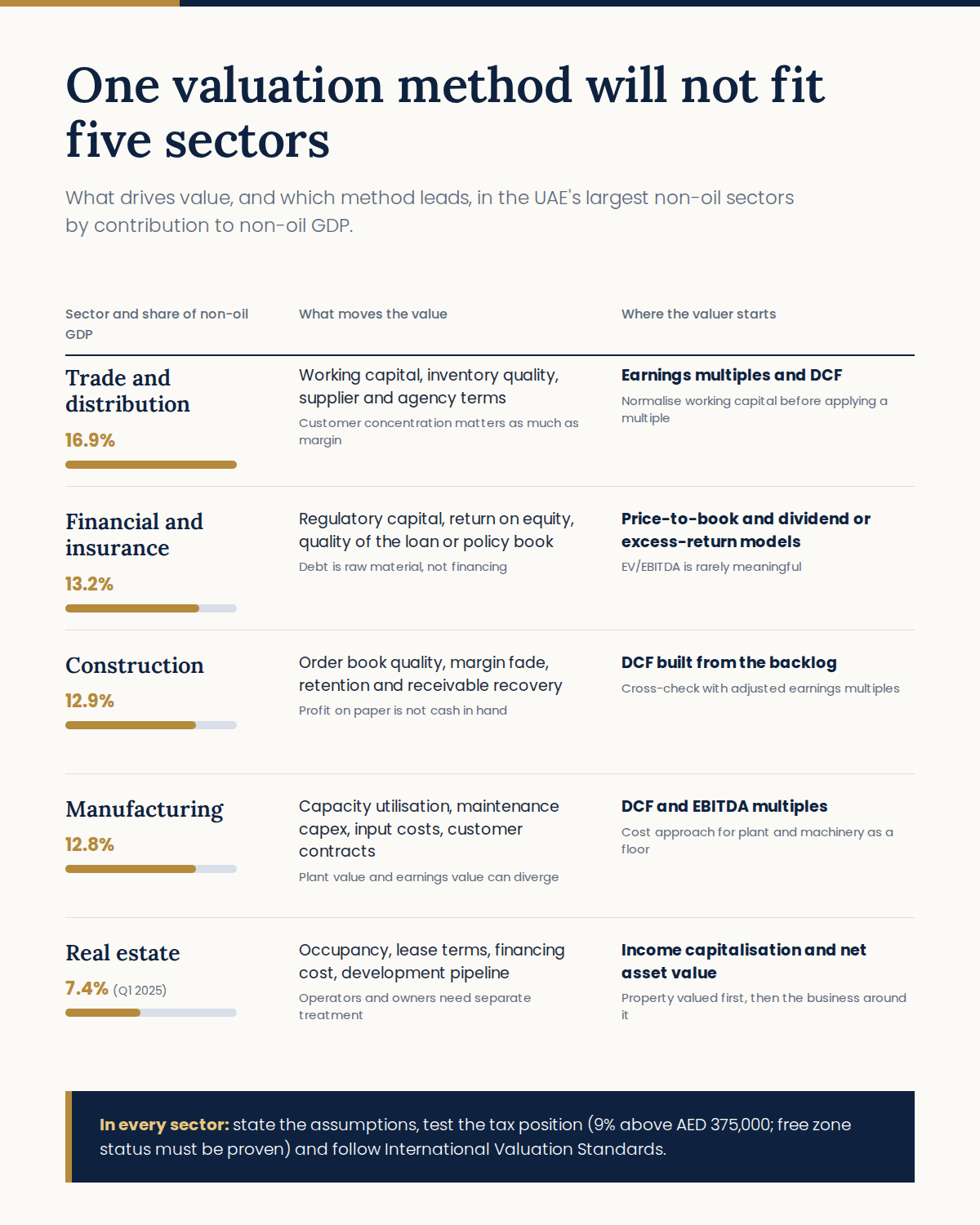
The UAE’s Federal Competitiveness and Statistics Centre reported that non-oil GDP grew 6.8 percent in 2025 to AED1.5 trillion, with trade holding the largest share of non-oil GDP at 16.9 percent, followed by financial and insurance activities at 13.2 percent, construction at 12.9 percent and manufacturing at 12.8 percent. Real estate sits next in the FCSC’s rankings; in the first quarter of 2025 it contributed 7.4% of non-oil GDP. wamfinancemiddleeast
These sectors also move at different speeds. Construction grew 11.1 percent in 2025, financial and insurance activities 10.4 percent and real estate 7.9 percent. A valuer cannot simply extend a fast year into the future, so the sector’s cycle shapes the forecast as much as the company’s own history. wam
The framework every valuer starts from
The International Valuation Standards recognise three approaches: income (such as discounted cash flow), market (comparable companies and transactions) and cost (asset-based). The latest edition of the standards became effective on 31 January 2025, with added attention to data and inputs and to documentation. Sector knowledge decides which approach carries the most weight and which inputs deserve the closest testing. iasplus
Tax applies across all five. The UAE corporate tax regime levies a standard 9 percent on taxable profits above AED375,000, so after-tax cash flow is the starting point for any income-based model. wam
1. Trade and distribution
What drives value. Trading companies rarely own much that is unique. Value comes from how efficiently they turn stock and receivables into cash, and from the contracts that keep goods flowing: distribution agreements, supplier credit terms, exclusivity and customer relationships. The scale of the opportunity is real: the UAE’s non-oil foreign trade reached approximately AED3.8 trillion in 2025, up 27% on 2024. That volume also draws competition, which is why margins and agency rights deserve scrutiny. tradearabia
How valuers approach it. Earnings multiples and DCF usually lead, but only after working capital has been normalised. Aged inventory, disputed receivables and unusually generous or tight supplier credit can distort both earnings and cash. Customer concentration also matters: one buyer representing most of revenue is a risk a multiple does not capture.
Free zone note. Many trading companies sit in free zones such as DMCC or JAFZA. Whether they enjoy a 0% rate on qualifying income depends on meeting the Qualifying Free Zone Person conditions, a point we cover in our guide to free zone company valuation in Dubai.
2. Financial services and insurance
What drives value. For a bank, finance company or insurer, debt and policyholder funds are the raw material of the business, not a financing choice. Value therefore depends on regulatory capital, the quality of the loan or policy book, funding cost and return on equity. Regulators differ by jurisdiction: the Central Bank of the UAE onshore, the DFSA in DIFC and the FSRA in ADGM.
How valuers approach it. EV/EBITDA is rarely meaningful here. Valuers lean on price-to-book and price-to-earnings comparisons, dividend discount or excess-return models, and an assessment of whether capital can be released to shareholders. Accounting for expected credit losses and insurance contracts (IFRS 9 and IFRS 17) changes reported earnings, so reported profit needs careful interpretation.
3. Construction and contracting
What drives value. The order book, the margin on each contract and, above all, cash conversion. Profit recognised over the life of a contract (IFRS 15) may sit in contract assets, retentions and receivables for a long time before it becomes cash. Margin fade on long projects is another common source of disappointment.
How valuers approach it. A DCF built contract by contract from the backlog, with adjusted earnings multiples as a cross-check. We test how much of the backlog is signed, how realistic the margins are, and how long retentions and variations take to collect. A contractor with a strong income statement and weak cash conversion can be worth less than its profit suggests.
4. Manufacturing
What drives value. Capacity utilisation, input cost exposure, maintenance capital spending and the stability of customer contracts. A plant running at low utilisation may carry significant embedded value if demand is rising, or hidden weakness if it is not.
How valuers approach it. DCF and EBITDA multiples lead, with the cost approach used for plant and machinery as a reference point. The key judgement is how much capital spending is needed just to stand still. EBITDA that ignores heavy replacement capex flatters the business.
5. Real estate
What drives value. For owners of income-producing property: occupancy, lease terms, rent levels and financing cost. For developers: the pipeline, pre-sales, cost to complete and the timing of cash release. Investment property is commonly measured at fair value (IAS 40 and IFRS 13), which links accounting and valuation closely.
How valuers approach it. Income capitalisation and net asset value are the usual anchors. Operating companies that own property, such as hotels or malls, are valued in two layers: the property itself, then the business around it. Real estate grew 7.9% in 2025, yet that does not justify extrapolating growth into a forecast. Property cycles are a risk to test, not a trend to assume.
A hypothetical example: the distributor
This scenario is illustrative and not based on a real client.
A Dubai-based distributor reports EBITDA of AED 8.0 million. During review, the valuer finds that the company rents its warehouse from a shareholder at well below market rate. Charging market rent reduces EBITDA by AED 0.6 million to AED 7.4 million. At an illustrative 6x multiple (chosen for the example, not a market benchmark), the difference is AED 3.6 million before any inventory adjustment. If part of the stock is also slow-moving and needs a write-down, equity value falls further. The headline number was real; the sustainable number was lower.
Checklist: what to prepare before a sector valuation
- Three years of audited financial statements and current management accounts
- A forecast with documented assumptions, not just a growth percentage
- Working capital detail: ageing of receivables, inventory and payables
- Contracts and agreements: customer, supplier, agency, lease and project contracts
- Related-party transactions and whether they are on market terms
- Corporate tax position, including free zone status where relevant
- Regulatory licences and capital positions for financial businesses
- Capex history and maintenance needs for asset-heavy businesses
Common mistakes
- Using one multiple for every sector. A multiple means something only when applied to comparable businesses.
- Ignoring cash conversion. Profit and cash diverge most in trade and construction.
- Assuming tax benefits last forever. Free zone status and group-level rules need testing, not assumption.
- Extrapolating a strong year. Sector growth in 2025 does not guarantee 2026.
- Leaving assumptions undocumented. Banks, auditors and investors ask for the reasoning, not only the result. Our guide on what a business valuation report should contain sets out what a robust report includes.
Frequently asked questions
Does the valuation method really change by sector?
Yes. The principles are the same, but the weight given to income, market and cost approaches changes with the business model. A bank is not valued like a manufacturer.
Which valuation method is most common in the UAE?
DCF and market multiples are widely used for operating businesses. Asset-based methods lead for property holders and are a reference point for asset-heavy firms.
How does UAE corporate tax affect business value?
It reduces after-tax cash flow for income above AED 375,000 at 9%. Free zone companies may pay 0% on qualifying income only if they meet the conditions, so the tax assumption needs support.
Are valuations done to international standards in the UAE?
Many valuers follow the International Valuation Standards, and auditors and investors often expect that. Confirm the standard in the engagement letter.
What documents does a valuer need?
Audited financials, a forecast, key contracts, working capital detail and the tax position. The checklist above covers the essentials.
How long does a sector valuation take?
It depends on the complexity and how quickly information is provided. A well-prepared company can shorten the process considerably.
What to consider next
Before the next transaction, funding round or reporting deadline, ask which sector lens a buyer or auditor will apply to your business, and whether your numbers hold up under it. A sector-aware review of working capital, cash conversion, capex and tax usually surfaces the issues that move value.
Speak with Valuation Arabia
If you are planning a sale, acquisition, fundraise or reporting exercise, our team can discuss how your sector, tax position and financial information affect value. Explore our business valuation services or contact us to discuss your requirements.
This article is general information and not financial, tax or legal advice.
