
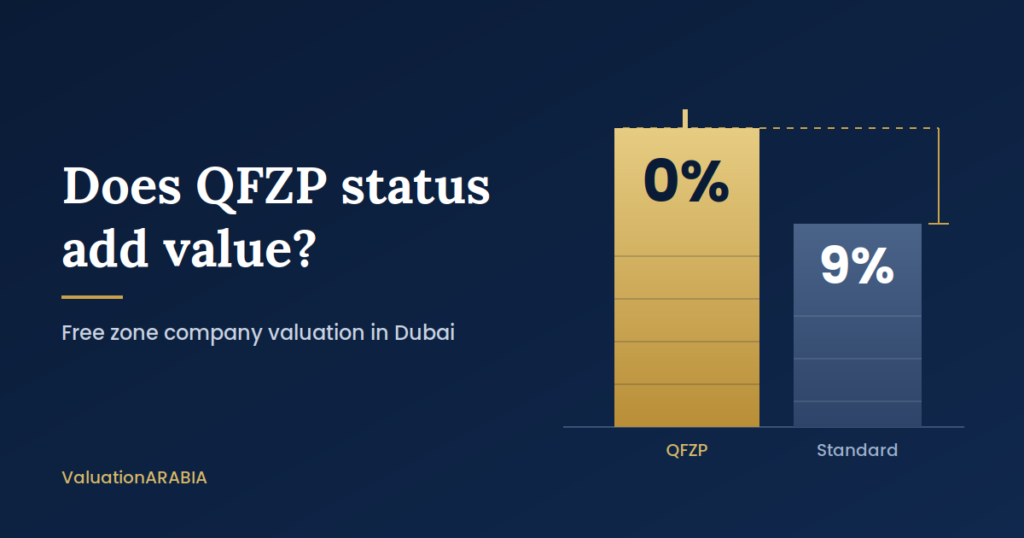
Quick answer: In most cases, Qualifying Free Zone Person (QFZP) status raises the value of a free zone company in Dubai, because qualifying income is taxed at 0% instead of 9%. But the uplift is not automatic. A valuer has to check whether the status can be kept, what it costs to keep, and what happens to the numbers if it is lost.
If you own, buy or sell a company in DMCC, JAFZA, DAFZA, Dubai Silicon Oasis or another UAE free zone, this question now comes up in almost every valuation conversation. Here is how it works in practice.
What QFZP status means for a free zone company
Since Corporate Tax started in the UAE, a free zone company is no longer simply “tax-free”. Under Article 18 of Federal Decree-Law No. 47 of 2022, a free zone company pays 0% only if it meets every condition to be a Qualifying Free Zone Person. In short, it must:
- keep adequate substance in the free zone (real staff, premises and activity)
- earn Qualifying Income
- stay within the de minimis limit on non-qualifying revenue
- comply with transfer pricing rules
- prepare audited financial statements
- not have elected to be taxed at the regular rate
Qualifying Income and Qualifying Activities are set out in Cabinet Decision No. 55 of 2023 and Cabinet Decision No. 100 of 2023. The list of Qualifying and Excluded Activities is now in Ministerial Decision No. 229 of 2025, which replaced Ministerial Decision No. 265 of 2023.
The de minimis limit is the lower of 5% of total revenue or AED 5 million. Non-qualifying income above that limit does not just get taxed at 9%. It puts the whole status at risk.
Why QFZP status can raise a company’s value
Most valuations rest on the cash a business will keep after tax. If a company moves from paying 9% to paying 0% on its profit, more cash reaches the owners every year.
Here is a simplified example. These are illustrative numbers, not a real valuation.
| Scenario | Annual pre-tax cash flow | Tax | After-tax cash flow | Indicative value |
|---|---|---|---|---|
| QFZP, 0% on all income | AED 10.0m | Nil | AED 10.0m | about AED 111.1m |
| Not a QFZP, 9% above AED 375,000 | AED 10.0m | about AED 0.87m | about AED 9.13m | about AED 101.5m |
| QFZP, with a 20% chance of losing status | AED 10.0m | Weighted | Weighted | about AED 109.2m |
Assumptions: 12% discount rate, 3% long-term growth, value calculated as next year’s cash flow divided by (discount rate minus growth). The model is simplified and ignores working capital, capex and the five-period limit on losing status.
In this case the 0% status adds roughly 8–9% to value. The third row shows the point that matters most to buyers: they rarely pay full price for a tax benefit that might disappear.
When QFZP status adds less value, or none
Do not assume the uplift in the table applies to every free zone company. We see it shrink or vanish in these situations.
1. The income is not really qualifying. Free zone companies that sell mainly to mainland customers, or that carry out Excluded Activities, may earn little or no Qualifying Income. The benefit then exists only on paper.
2. Substance is expensive. Keeping real offices, employees and decision-making in the free zone costs money. If those costs are close to the tax saved, the net gain is small.
3. The de minimis limit is close. A company that regularly earns non-qualifying revenue near the AED 5 million or 5% limit carries a real risk. One bad year can cost the status.
4. Losing status is not a one-year problem. A company that fails a condition ceases to be a QFZP from the start of that tax period and for the following four tax periods, so five periods in total. A valuer has to model that period at 9%, not just one year.
5. Large multinational groups face other rules. Groups within scope of UAE Top-up Tax (the Domestic Minimum Top-up Tax, from 1 January 2025) may find that a 0% rate does not hold at group level.
How valuers treat QFZP status in each valuation approach
Income approach (DCF). This is where the status matters most. We model the tax rate on each income stream and test whether QFZP status can be sustained into the terminal value. A common mistake is to assume 0% tax forever without testing the conditions.
Market approach. Comparable companies may have different tax treatment. If your company is a QFZP and the comparables pay 9%, earnings-based multiples need adjusting, and EBITDA multiples may need a closer look.
Asset approach. Mostly unaffected, but we check for potential tax liabilities from past periods, especially if status was claimed without proper documents.
Transactions. In a sale, buyers often ask for tax warranties and indemnities linked to QFZP status. These can affect the price, so the valuation and the deal terms should be consistent.
Does the free zone matter, or only the activity?
The activity matters far more than the location. A company in DMCC, JAFZA, DAFZA or Dubai Silicon Oasis does not get 0% simply because of its address. What counts is what it does, who it does it with, and whether it can prove substance. Two neighbours in the same free zone can have very different valuations for this reason.
What to prepare before a free zone company valuation
Having these ready saves time and strengthens the report:
- audited financial statements for each tax period
- a revenue split between qualifying and non-qualifying income, by customer type
- the free zone licence and its permitted activities
- proof of substance: lease, employee contracts, board and management records
- transfer pricing documentation for related-party transactions
- Corporate Tax registration and filings
- any written tax advice confirming QFZP status
A valuer relies on a qualified tax adviser to confirm QFZP status. The valuation then reflects that status, plus the risk of losing it.
Choosing a business valuation firm in UAE for your free zone company
If you are valuing a free zone company, the business valuation firm in UAE you choose should understand Corporate Tax as well as valuation methods. Ask whether the firm tests QFZP conditions such as substance, Qualifying Income and the de minimis limit before it applies a 0% tax rate in the model, and whether it shows the impact if that status is lost. A report that simply assumes 0% tax forever can overstate value and may not hold up with banks, investors, buyers or auditors. A good valuation report in Dubai should state its assumptions clearly, follow recognised standards such as the International Valuation Standards, and keep the valuation consistent with the deal terms.
Frequently asked questions
Does QFZP status always increase company valuation?
No. It usually increases value when qualifying income is a large and stable share of revenue and the conditions can be met every year. If the status is uncertain or expensive to keep, the increase is smaller.
What is the corporate tax rate for a free zone company in Dubai?
A QFZP pays 0% on Qualifying Income. Income that does not qualify is taxed at the standard 9% rate on taxable income above AED 375,000, unless the company has lost its status entirely.
What happens to value if a company loses QFZP status?
Value normally falls, because profit is taxed at 9% from the start of the relevant tax period for that period and the next four. Buyers also tend to apply a risk discount before it happens.
Is a free zone company valuation different from a mainland company valuation?
The methods are the same: DCF, market and asset approaches. The difference is in the tax assumptions, the substance requirements and the extra risk review needed to test QFZP status.
Who needs a free zone company valuation in the UAE?
Owners selling or bringing in investors, buyers doing due diligence, shareholders exiting, and groups restructuring or transferring shares between related parties.
Get a free zone company valuation in Dubai
Whether QFZP status adds AED 5 million or AED 50 million to your company depends on your own income mix, your substance and your risk profile. At ValuationARABIA, our Dubai team prepares independent valuation reports that reflect the Corporate Tax position of free zone companies, built on recognised methods and ready for banks, investors and regulators.
Talk to our Dubai valuation team for a company valuation.
This article is general information and not tax or legal advice. Corporate Tax rules and ministerial decisions are updated from time to time, so confirm your QFZP position with a licensed tax adviser.
