
How a Growing Technology Company Prepared for Employee Equity Issuance with a 409A Valuation
How a Growing Technology Company Prepared for Employee Equity Issuance
Determining the fair market value of common stock so that stock options reward employees instead of creating tax problems.
Why a 409A Valuation Matters
Section 409A of the US Internal Revenue Code governs non-qualified deferred compensation. If stock options are granted below the fair market value of the underlying shares, they may create adverse tax consequences for the employees they were meant to reward.
A properly documented independent valuation provides a supportable fair market value conclusion and helps the Board set a defensible strike price for employee option grants.
For a startup, 409A is not merely a compliance exercise. It protects employees, supports Board approvals and creates a file that can stand up to future financing, audit and diligence scrutiny.
Five connected valuation questions needed to be answered.
The client was a venture-backed SaaS company incorporated in Delaware, with product development operating through an Indian subsidiary. After completing its Series A round, the company entered a new hiring phase and wanted stock options to be a core part of employee compensation.
Fair Market Value
What is the common stock actually worth today?
Company Stage
Which valuation methods are appropriate for this stage?
Preferred vs Common
How much of the round price reflected investor rights?
Recent Financing
Could the Series A be relied upon as strong evidence of value?
Market Conditions
Had the market moved enough to justify an adjustment?
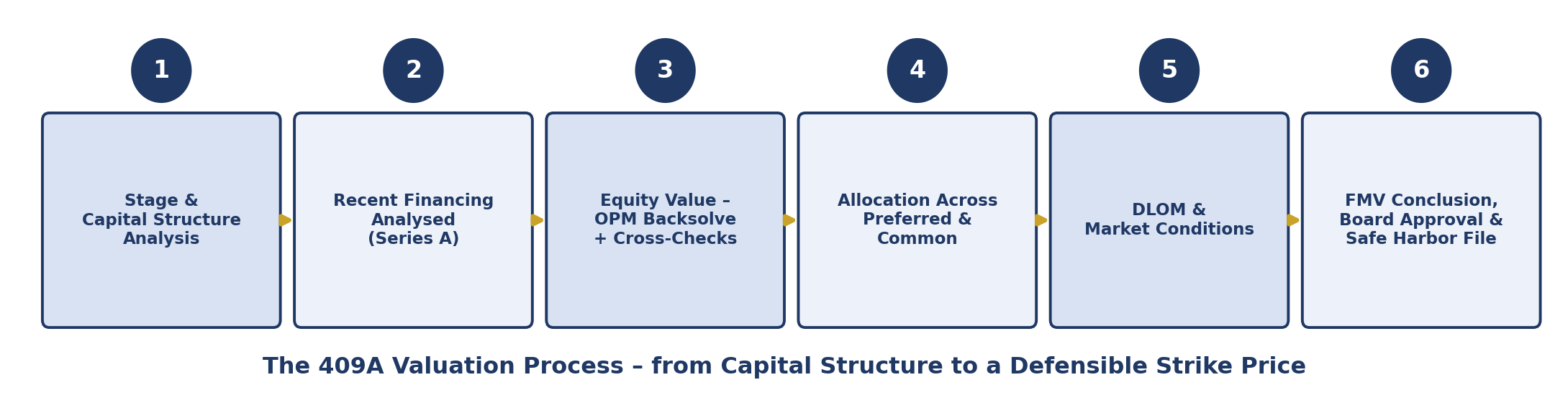
The 409A Valuation Process
A Deep Dive
Valuation Framework
The engagement relied on the recent financing as the primary anchor of value, then used an allocation methodology appropriate for an early-stage private company.
Establishing the Company's Stage
The company was assessed as early stage: product launched, initial recurring revenue, institutional capital raised, but no immediate liquidity event. This supported use of the recent financing and the OPM allocation methodology.
Analysing the Recent Financing
The Series A round was examined in detail including parties, pricing, timing and all attached rights such as liquidation preference, conversion, governance and anti-dilution features.
Preferred Versus Common
The last round price was not treated as the value of all shares. Preferred investors buy protections and rights that common stock does not have. That economic gap needed to be measured, not assumed.
Backsolve and Option Pricing Method
The backsolve worked backwards from the observed Series A price to infer total equity value. The Option Pricing Method then allocated that value across the capital structure to estimate the value of common shares before marketability discount.
Discount for Lack of Marketability
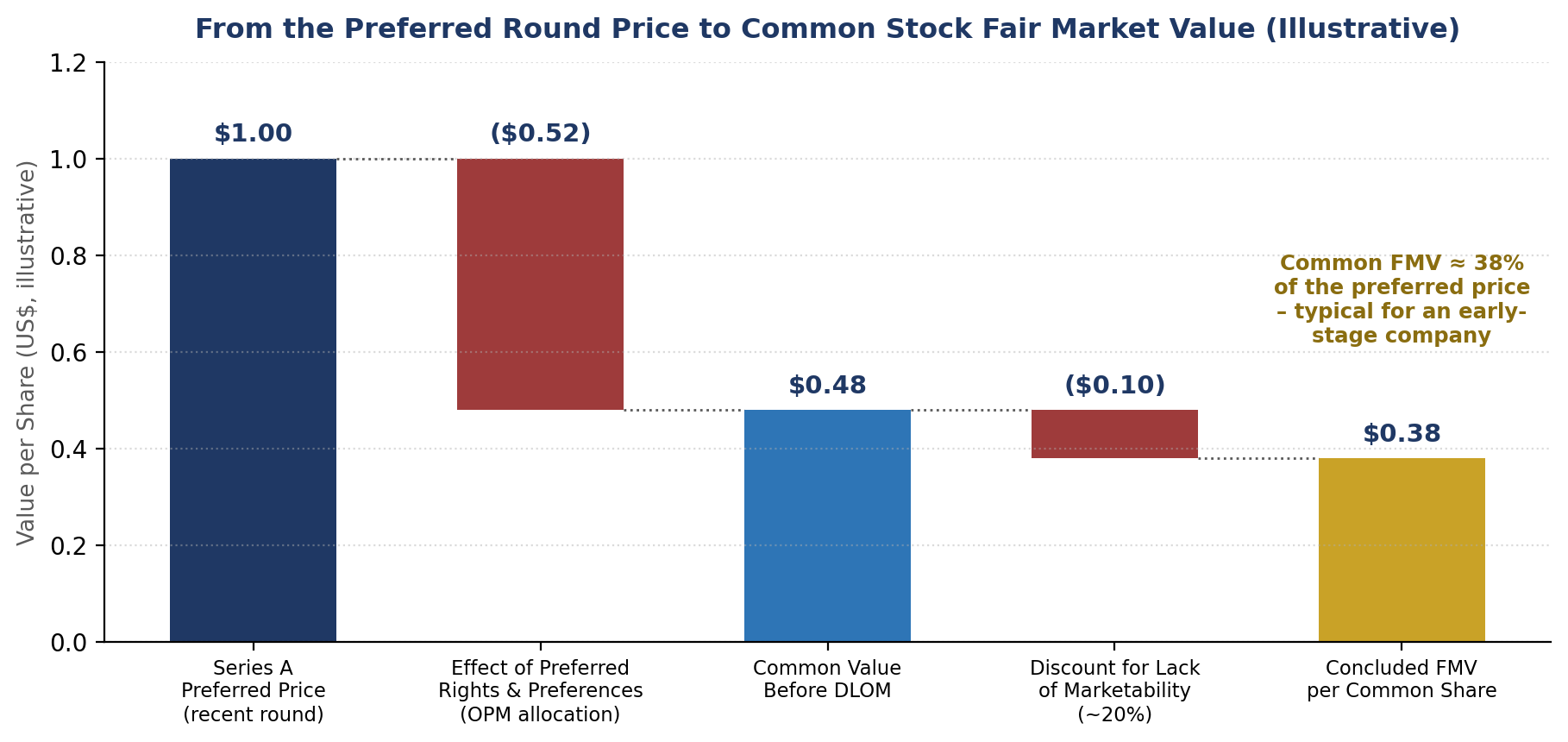
A DLOM was applied to reflect the illiquid nature of private company common stock. In the illustrative example, this reduced the value from $0.48 to $0.38 per common share.
Market Conditions and Corroboration
Public SaaS multiples, venture conditions and company performance against plan were reviewed. The Series A remained a relevant anchor of value and comparable market evidence was used as a reasonableness check.
Conclusion, Board Approval and Safe Harbor File
The final FMV conclusion supported Board approval of option grants and provided a documented valuation file for auditors, counsel and future diligence processes.
Preferred and Common Stock Are Not Worth the Same
Illustrative Bridge from Preferred Price to Common FMV
The Safe Harbor Refresh Cycle
& Board approval
of option grants
scheduled refresh
major contract or M&A discussions - triggers an earlier update
Structured, supportable, and ready for future scrutiny.
A Defensible Strike Price
The Board approved employee option grants at a strike price supported by an independent valuation.
Employee Protection
The option grants were structured to create upside rather than expose employees to punitive tax outcomes.
Diligence Readiness
Methodology, assumptions and inputs were documented for future financing, audits and diligence processes.
A Sustainable Cadence
The company left with a clear refresh discipline recognising 409A valuation as an ongoing governance process.
What this case study demonstrates
The last round price is not the value of common stock.
Preferred equity carries economic and governance rights that common stock does not.
Stage drives methodology.
For an early-stage company, a recent arm’s-length round can be strong evidence of value when appropriately analysed.
The financing must be analysed, not merely cited.
The terms, rights and timing of the financing all matter for valuation.
Marketability has a price.
A DLOM helps translate a pre-discount common value into a more realistic FMV for private company shares.
A 409A valuation is a cycle, not an event.
Twelve months or a material event, whichever comes first, should trigger a refresh.
Need a defensible valuation for employee equity?
Discuss your capital structure, financing background and valuation requirements with our specialists.
Strictly Private & Confidential — Client identity withheld; all figures are illustrative. This case study is general information only and does not constitute US tax or legal advice.
